
Analytics 101:
How to Use Data to Drive Smarter Marketing Decisions

In marketing, guessing is expensive. The days of “let’s try it and hope for the best” are long gone. Budgets are tight, timelines are fast and every dollar has to prove it’s doing something useful. That’s where analytics steps in. Analytics turns guesswork into growth by helping you understand what’s working, what’s not and how to make your marketing stronger.
At its heart, analytics is the practice of collecting data, understanding what it’s telling you and turning those insights into better decisions. It’s not about chasing numbers for the sake of it. It’s about clarity. It’s about accountability. And honestly, it’s about giving your team the confidence to know their efforts are paying off.
Think of analytics as the place where creativity and performance meet. It shows you which messages land, which platforms pull their weight and how to get more from your investment. Because analytics is built on actual behavior instead of assumptions, it helps you optimize faster and spend smarter.
In this guide, we’ll break down what analytics really means, why it matters, key metrics, the tools that help you make sense of it all and a simple framework for putting analytics to work in your strategy. Whether you’re new to this or just ready for a cleaner approach, you’ll get a clear roadmap for using data to fuel growth.
What Is Analytics?
Analytics is the practice of measuring, managing and analyzing marketing performance so you can maximize effectiveness and return on investment. In other words, it’s how you turn raw data into real insight.
Think of it as the behind-the-scenes engine that helps your marketing run smarter. Every campaign, click, visit and action creates a trail of information. Analytics takes all that raw, scattered data and turns it into something you can actually use. Instead of guessing which message landed or which audience was most engaged, analytics shows you. It gives you the ability to see what’s working in real time, understand why certain tactics outperform others and spot opportunities you might have missed.
It’s also a way to keep your marketing grounded. When you’re making decisions based on real behavior instead of assumptions, you increase your impact. You know where to invest more, where to pull back and where to experiment. And over time, these consistent data-backed decisions compound into stronger performance and return on investment.
There are three main stages in the process:
1. Collect
Your data comes from your website, social channels, paid campaigns, CRM, email platform and more. Every click, view and action leaves a data trail that you can collect to inform your marketing decisions.
2. Analyze
This is where the numbers start talking. You look at trends, compare performance and figure out what the data actually means. Knowing that engagement dropped is one thing. Understanding why is where the value is.
3. Act
Data without action isn’t helpful. Analytics gives you direction by suggesting where changes might improve your performance. Maybe you adjust creative, shift budget or refresh your targeting. The point is to derive actionable insights from the data, then actually act on them.
And here’s a helpful distinction a lot of teams mix up:
Reporting vs analytics
- Reporting tells you what happened. (“Our email open rate fell 8%.”)
- Analytics tells you why it happened and what to do next. (“Opens dropped because we changed our send time. Let’s test mornings again and refresh subject lines.”)
Reporting looks backward. Analytics helps you move forward.
Why Analytics Matters in Marketing
If marketing is about building relationships, analytics is the translator. It helps you understand what people respond to, what they skip and how your campaigns really perform. Here’s why it’s essential.
1. Data-driven decisions
One of the biggest benefits of analytics is the ability to make data-driven decisions. Instead of relying on gut feelings or hoping a tactic will pay off, you have real evidence that points you in the right direction. Analytics shows you what your audience is responding to, which channels are driving results and where your dollars actually make an impact. When your decisions are grounded in data, your marketing becomes more focused, more intentional and a whole lot more effective.
2. Performance measurement
Analytics is essential for performance measurement because it shows you exactly how your marketing is doing, not just how you think it’s doing. Every channel, tactic and message plays a different role, and analytics helps you see which ones are actually delivering results. You can spot what’s driving traffic, what’s converting and what’s quietly burning budget in the background. It also helps you compare performance over time so you can tell whether your efforts are improving, plateauing or slipping.
3. Budget optimization
Analytics plays a huge role in budget optimization because it shows you where your money is actually making a difference. Instead of spreading your budget evenly or guessing which channels deserve more investment, you can see what’s performing and what’s not. Maybe your paid search campaigns are driving high-quality leads while a social campaign is soaking up spend with little return. Analytics makes those patterns obvious, so you can shift dollars toward what works and cut back on what doesn’t. Over time, this keeps your budget tighter, smarter and focused on the tactics that deliver real results instead of draining resources.
4. Customer understanding
Analytics helps you understand your customers by showing you what they click on, how they move through your website, which messages they respond to and what makes them take action. You start to see patterns in their behavior about what they prefer, when they engage and where they drop off. Over time, those insights paint a much clearer picture of who your customers really are and what they need from you. When you understand them at that level, you can create marketing that feels more relevant, more helpful and a lot more effective.
5. Predictive insights
Analytics uses data tied to past behavior to help you understand what’s likely to happen next. Instead of being caught off guard by seasonal dips or sudden changes in engagement, you can spot patterns early and plan ahead. Maybe your email open rates always slide in the fall or certain audiences convert better at specific times of year. Predictive insights surface those trends so you can adjust your strategy before problems show up.
6. Accountability
Analytics helps marketing prove its value by replacing vague impressions with real results. Instead of saying a campaign “went well,” you can show exactly how many people it reached, how they engaged and what actions they took. You can tie efforts directly to leads, sales and revenue, which makes conversations with leadership a whole lot easier. It also highlights how different channels contribute to the bigger picture, so you’re not fighting for budget based on opinion alone. With solid analytics, marketing becomes a measurable, accountable part of the business.
In other words, it pays to pay attention.
The Types of Analytics
Analytics isn’t one thing. It’s a collection of different lenses that help you understand what’s happening and what to do next.
Here are the big four.
1. Descriptive Analytics — What happened?
Descriptive analytics looks at past performance and sums up the key numbers so you can see the big picture. Think of it as the highlight reel. It shows how many people visited your site, how your ads performed and which posts grabbed attention. Descriptive analytics doesn’t explain why something happened, but it gives you the clear baseline you need before digging deeper. It’s the foundation of smart analysis.
Example:
“Website traffic grew 15% last quarter.” It’s the scoreboard, but not the playbook.
2. Diagnostic Analytics — Why did it happen?
Diagnostic analytics goes one step deeper by helping you understand why your marketing performed the way it did. Instead of just showing the numbers, it connects the dots and reveals the causes behind them. Maybe website traffic spiked because you launched a new campaign, or engagement dropped after a messaging change. Diagnostic analytics digs into those relationships so you can see what’s influencing your results. It helps you separate coincidence from real patterns and gives you the context you need to make smarter decisions.
Example:
“Traffic increased because we launched a paid search campaign.” This is where the puzzle pieces start to fit together.
3. Predictive Analytics — What’s likely to happen next?
Predictive analytics helps you look ahead by using past data to forecast what’s likely to happen next. It’s about spotting patterns in your audience’s behavior, campaign performance and seasonal trends so you can plan ahead. Maybe email engagement always dips in certain months or certain audiences tend to convert at higher rates during specific times of year. Predictive analytics brings those insights to the surface so you can adjust your strategy before issues show up.
Example:
“Email open rates will likely dip in Q4 unless we refresh content.” It’s not magic. It’s patterns.
4. Prescriptive Analytics — What should we do about it?
Prescriptive analytics is where data turns into real direction. Instead of just telling you what happened or what might happen next, it gives you clear recommendations on what to do about it. It looks at patterns, past performance and predicted outcomes, then suggests the actions most likely to drive results. Maybe it tells you to shift budget to a high-converting audience, update creative that’s slowing engagement or double down on channels that consistently outperform. Prescriptive analytics is the step that turns insights into strategy and strategy into more effective marketing.
Example:
“Increase budget for audience segments with the highest conversion rates.” It’s the guidance that helps you move from reacting to leading.
Pro Tip
The best marketing teams use all four. You learn from the past, understand the present and shape the future.
Key Metrics Every Marketer Should Track
Metrics can get overwhelming fast. The trick is focusing on what actually matters. Breaking them down by funnel stage helps keep everything clear and intentional.
1. Awareness Metrics
These show whether your brand is being seen.
- Impressions: How many times your content is displayed
- Reach: How many people saw it
- Website traffic: Who’s coming to your site and from where
- Share of voice: How often your brand is mentioned compared to competitors
2. Engagement Metrics
These show how people interact with your content.
- Click-through rate (CTR): How many people clicked
- Social engagement: Likes, comments, shares and saves
- Engagement rate: How many people engage with your content overall
- Time on page: How long people stick with your content
3. Conversion Metrics
These measure how well you turn interest into action.
- Conversion rate: How many people complete your desired action
- Cost per acquisition (CPA): How much it costs to get one customer or lead
- Lead-to-customer rate: How many leads become paying customers
- Return on ad spend (ROAS): How much revenue you get per advertising dollar
4. Retention Metrics
These show long-term value and loyalty.
- Customer lifetime value (CLV): Total expected revenue from a customer
- Churn rate: Rate at which customers leave
- Net promoter score (NPS): How likely customers are to recommend you
Insight
Don’t track everything. Track what matters to your goals and your funnel stage.
The Tools of Marketing Analytics
There’s no shortage of analytics tools out there and you shouldn’t worry about using all of them. Use the ones that give you a clear view of your performance.
1. Google Analytics 4 (GA4)
GA4 tracks website and app behavior with event-based measurement and shows how users move across your digital experience.
2. Google Looker Studio
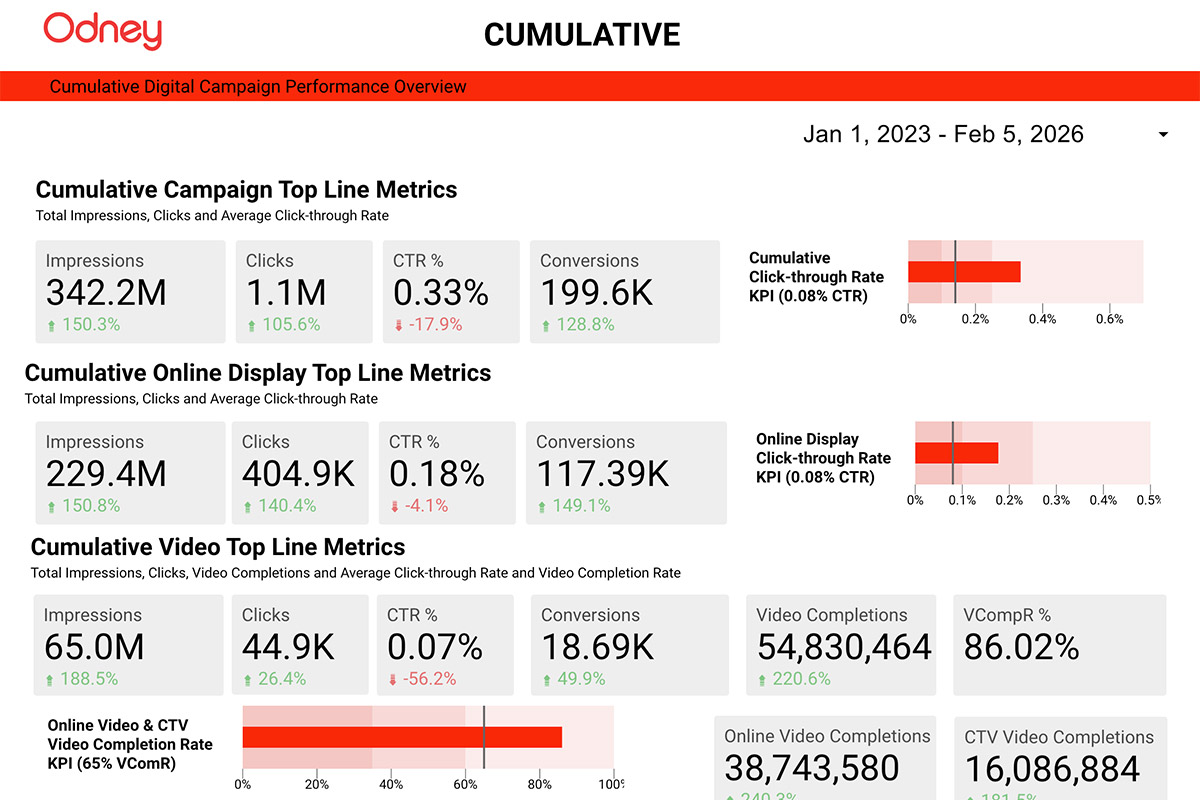
Looker Studio helps you build dashboards that bring multiple data sources together.
At Odney, we build custom dashboards for every client so their data tells a clear story.
3. Social Media Insights
Meta, LinkedIn, TikTok and X offer built-in dashboards that show engagement, reach, demographics and campaign performance.
4. CRM Systems
Platforms like HubSpot and Salesforce track lead sources, sales activity and lifetime value.
5. Marketing Automation Tools
Tools like Mailchimp, Klaviyo and Marketo help you track email performance, audience behavior and automated campaign success.
6. Paid Media Dashboards
Google Ads and Meta Ads Manager help you monitor ROI, CPC and performance so you can optimize spend.
Pro Tip
Connect your data whenever possible. Marketing channels work together and your analytics should too.
Building a Data-Driven Marketing Strategy
Here’s how to turn analytics into action with a simple, repeatable framework.
Step 1: Define clear goals
Step one in building a data-driven strategy is defining clear goals. Without knowing what you’re aiming for, it’s almost impossible to measure success or decide what to optimize. That’s where SMART goals come in. They’re specific, measurable, achievable, relevant and time-bound, which gives you a concrete target instead of a vague direction. It keeps everyone aligned, sets expectations and gives your analytics something meaningful to measure against. Clear goals make your marketing more focused, more intentional and way easier to evaluate.
Example:
“Increase qualified leads by 20% in six months.”
Step 2: Identify key metrics
Step two is all about choosing the key metrics that actually matter. Once you know your goals, you can zero in on the KPIs that reflect real progress. Skip the vanity numbers that look impressive but don’t move the business forward and focus on the metrics that tie directly to what you’re trying to achieve. When you choose the right KPIs, your data becomes clearer, your decisions get easier and your team knows exactly what success looks like.
Example:
If your goal is awareness, track reach and traffic. If it’s conversions, watch CPA and conversion rate.
Step 3: Collect and integrate data
Step three is collecting and integrating your data so everything works together instead of living in separate silos. Your website, CRM, paid media platforms and marketing automation tools all capture valuable information, but you only get the full picture when those systems connect. When your data flows into one place, you can see how someone first discovered your brand, how they engaged with your content and what finally led them to convert. Integrated data gives you a unified view of your audience and a stronger foundation for every decision you make.
Example:
A customer clicks a Google ad, visits your website, signs up for your email list and later becomes a lead in your CRM. If your systems aren’t connected, those touchpoints look like four separate interactions. But when your website analytics, Google Ads, email platform and CRM are integrated, you can see the entire journey from first click to conversion.
Step 4: Analyze trends
Step four is analyzing trends so you can understand what your data is really telling you. This is where you look beyond the surface-level numbers and start spotting patterns in how people behave. Maybe certain channels consistently drive high-quality traffic or a specific type of content always performs well. On the flip side, you might find roadblocks you didn’t realize were there, like users dropping off at a particular step or ads that get clicks but never convert. Analyzing trends helps you see what’s helping, what’s hurting and where to focus your attention for the biggest impact.
Example:
You notice website traffic from social media has been rising for three months, but conversions from that same traffic stayed flat. After digging in, you discover most visitors from social are landing on a blog post but never moving deeper into the site. That’s the roadblock. With that insight, you update the post to include stronger calls to action and internal links that guide readers toward your product or service pages. The next month, conversions from social jump. By spotting the pattern and identifying the bottleneck, you turned a passive trend into a real performance boost.
Step 5: Take action
Step five is where the real magic happens, because this is when you actually put your insights to work. Once you know what’s helping and what’s holding you back, you can make meaningful adjustments to your creative, targeting or budget. Maybe your audience is responding better to video than static images, or a certain keyword is converting way more efficiently than the others. This is your chance to shift resources toward what works and cut what doesn’t. Taking action turns data into momentum and keeps your marketing moving forward instead of letting insights sit on a dashboard collecting dust.
Example:
Move budget from underperforming keywords to top converters.
Step 6: Test, measure, repeat
Step six is all about testing, measuring and repeating so your marketing keeps getting stronger over time. No strategy should stay frozen in place. Once you make changes, you want to test them, see what actually improved and adjust again. Maybe you A/B test two headlines, try new targeting or swap out creative to see what resonates. The point is to build testing into your regular rhythm, not treat it like a once-a-year project. When you consistently test and measure, you learn faster, waste less and keep your marketing moving in the right direction.
Example:
You run an email campaign and notice the click rate is lower than expected. So next time, you A/B test two subject lines and two versions of your call to action. One combination clearly outperforms the others, so you use that insight in your next send. Then you test again, this time maybe timing, maybe layout. Each round teaches you something new, and over a few cycles your open and click rates steadily climb. By building testing into your routine, you’re not guessing your way forward. You’re improving step by step, using real results to guide every decision.
Common Analytics Mistakes
Even seasoned marketers hit a few bumps here. Here are the big ones to watch for.
1. Tracking too many metrics
Tracking too many metrics can bury you in numbers that don’t actually help. When everything feels important, nothing stands out and it becomes harder to spot real insights or make confident decisions. Focusing on a small set of meaningful metrics keeps your reporting clear, your priorities sharp and your strategy easier to manage.
Fix: Stick to 5–10 core KPIs.
2. Ignoring data quality
Ignoring data quality is one of the fastest ways to derail your insights. If the information you’re working with is incomplete, outdated or tracked incorrectly, your decisions will be off target too. Clean, accurate data gives you a solid foundation, sharper insights and a lot more confidence in the choices you make.
Fix: Audit your tracking and clean your CRM regularly.
3. Overvaluing vanity metrics
Overvaluing vanity metrics can give you a false sense of success. Likes and views might look good on the surface, but they don’t always lead to sales or meaningful engagement. Focusing on metrics that actually drive revenue keeps your strategy grounded, your priorities aligned and your decisions tied to real business results.
Fix: Prioritize metrics tied to outcomes like Conversion Rate, Return on Ad Spend, etc.
4. Not segmenting audiences
Not segmenting your audience means you’re looking at blended data that smooths over important differences. One group might be converting at a high rate while another barely engages, but you’d never see it in the averages.
Fix: Break results down by source, demographic or behavior.
5. Not acting on insights
Not acting on insights is one of the biggest missed opportunities in marketing. You can have beautiful dashboards and endless reports, but nothing changes until you make a decision. When you act on your insights, you unlock the real value of your data and keep your marketing moving forward.
Fix: Hold regular review sessions to turn insight into action.
Insight:
Analytics isn’t about data. It’s about making better choices.
The Future of Marketing Analytics
Analytics is evolving fast and changing the way teams make decisions. AI is improving predictions, privacy rules are shifting how data is collected and real-time insights are becoming the new standard. The future isn’t just about more data. It’s about smarter, more connected tools that help marketers move with confidence.
1. AI and predictive modeling
AI and predictive modeling are giving marketers a powerful edge. Machine learning can spot patterns humans might miss, forecast future behavior and even recommend next steps automatically. It helps teams optimize campaigns faster, personalize experiences at scale and make smarter decisions without waiting for long reporting cycles.
2. Privacy-first measurement
Privacy-first measurement is becoming the new normal as third-party cookies disappear. Marketers are shifting toward first-party data and consent-based tracking to understand customers in a more transparent, trustworthy way. It means collecting the information people choose to share and using it responsibly to deliver better, more relevant experiences.
3. Real-time analytics
Real-time analytics gives teams instant insight into how campaigns are performing so they can adjust messaging, targeting or budget on the fly. Instead of waiting for weekly reports, marketers can make quick, informed decisions in the moment. It keeps campaigns agile and helps capture opportunities before they pass.
4. Unified data systems
Unified data systems bring everything together by giving you a single view of your customer across marketing, sales and service. Instead of juggling disconnected tools, you see every interaction in one place. It makes reporting cleaner, teamwork easier and decision-making a lot more informed and consistent.
5. Data storytelling
Data storytelling turns numbers into narratives people can actually understand and act on. Instead of overwhelming teams with charts, you translate insights into clear takeaways that explain what’s happening and why it matters. It builds alignment, inspires action and helps decision-makers connect the dots faster.
Forecast:
Analytics is becoming more strategic, more predictive and more human-centered. It’s not about spreadsheets. It’s about clarity and direction.
Conclusion
Analytics turns marketing into something you can measure, improve and scale. It gives you the clarity to understand what’s working, the confidence to adjust what isn’t and the power to spend smarter instead of spending more.
You don’t have to start big. Track a few meaningful metrics, look for patterns and commit to making one data-driven improvement each week. Those small steps add up fast and help you build momentum without feeling overwhelmed. Over time, you’ll make more confident decisions, waste less budget and shape a marketing strategy that gets stronger with every insight you act on.